


2025 has been a defining year for crypto, not because prices moved, but because structure emerged and crypto proved it could survive scrutiny.
Institutional capital arrived cautiously. Regulators moved from reaction to design. Infrastructure matured. Security failures exposed weak foundations. And real-world use cases finally began to matter more than narratives.
Based on how the market unfolded in 2025, here are 10 predictions from HUMB for 2026, based on observable data, regulatory movement and institutional behavior.
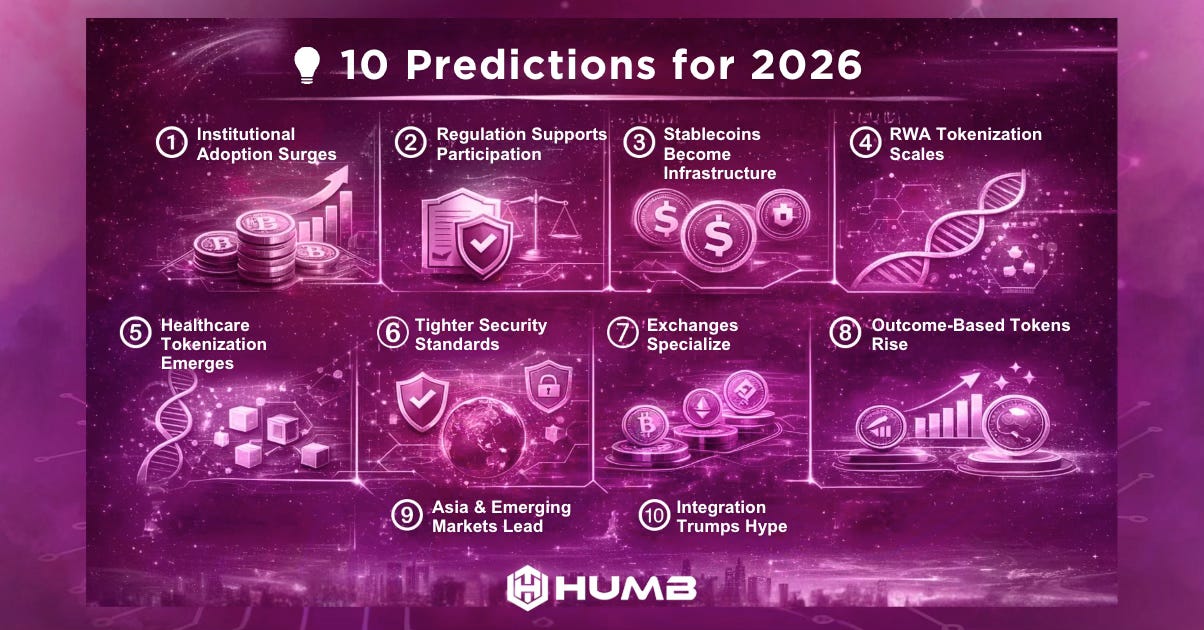
1. Institutional Capital Becomes the Primary Market Driver
Why this is happening
In 2025, spot Bitcoin ETFs accumulated tens of billions of dollars in assets. Bloomberg and Reuters coverage consistently highlighted that ETF flows were dominated by asset managers, pension allocators and long-term portfolios; not retail traders. As pricing models and custody standards align with traditional finance, institutions will increasingly allocate capital to digital assets bringing stability, depth and macro relevance to markets.
CME data also showed steady growth in institutional futures and options volume, indicating professional risk management rather than speculative positioning.
What it means in 2026
Markets become allocation-driven instead of hype-driven. Volatility compresses structurally and liquidity concentrates around high-conviction assets.
2. Regulation Shifts from Resistance to Participation
Why this is happening
The European Union’s MiCA framework moved from legislation to implementation, signaling that regulators now prefer supervision over exclusion. Financial Times reporting in 2025 emphasized that regulators are focusing on licensing, disclosures and custody standards not bans. What was once a debate about whether crypto should exist is now about how it interacts with law, finance and public policy. Hopefully legal certainty will accelerate adoption and reduce jurisdictional risk.
FATF updates reinforced the fact that crypto is now part of the global financial system, requiring alignment rather than isolation.
What it means in 2026
Compliant platforms scale faster. Regulatory clarity unlocks institutional participation and reduces jurisdictional arbitrage.
3. Stablecoins Become Financial Infrastructure
Why this is happening
BIS and Federal Reserve research in 2025 highlighted stablecoins as efficient settlement instruments rather than speculative assets. Chainalysis data showed that stablecoin transaction volumes exceeded most other crypto categories, particularly in payments and remittances as stablecoins can rival legacy settlement systems in speed and cost. As on-chain settlement becomes widespread, we see stablecoins rapidly evolving from crypto artifacts into payment rails and settlement layers.
This was bolstered by the fact that banks and fintech firms began piloting regulated stablecoins for treasury and cross-border use.
What it means in 2026
Stablecoins become the default rails for payments, settlements and incentive distribution especially in sectors like healthcare.
4. Real-World Asset (RWA) Tokenization Moves to Production
Why this is happening
Where 2024–25 saw tokenization experiments, 2026 will see institutional grade issuance and trading of RWAs and not just digital proxies. BCG and ADDX reports projected tokenized assets to reach trillions in value by the end of the decade, citing bonds, treasuries and funds already issued on-chain in 2024–25. In 2026 we see tokenized bonds, credit, treasuries and infrastructure assets unlocking new capital flows and fractional ownership.
BlackRock and JPMorgan’s tokenization initiatives validated that RWA is no longer experimental rather it’s institutional.
What it means in 2026
Tokenization becomes a capital markets tool, not a crypto novelty.
5. Healthcare Tokenization Emerges as a Distinct Asset Class
Why this is happening
Healthcare impacts 100% of humanity, yet traditional capital markets rarely tokenize this sector meaningfully. WHO and OECD publications in 2025 highlighted unsustainable healthcare financing models and the need for outcome-based systems. At the same time, digital health adoption and data standardization accelerated globally. In 2026 we envisage a big push for healthcare-linked tokens, tied not to speculation but to measurable outcomes; aligning capital flows with patient outcomes, real usage data and incentives, transforming how health systems are funded, measured and improved.
This creates the conditions for tokenized incentives, outcomes and infrastructure, if done compliantly.
What it means in 2026
Healthcare tokens shift from concept to regulated instruments tied to measurable outcomes, not speculation.
6. Security Becomes a Competitive Advantage
Why this is happening
Chainalysis’ 2025 crypto crime reports documented multi-billion-dollar losses from hacks, many tied to weak custody and key management. Regulators increasingly referenced NIST and ISO security frameworks in crypto oversight discussions as institutional adoption requires robust custody, proof of reserves and verifiable audit trails - not just promises.
With AI-driven security tools and real-time monitoring are already shaping defensive strategies, institutions now evaluate platforms based on security maturity, not feature sets.
What it means in 2026
Security is no longer hygiene - it’s differentiation.
7. Exchanges Specialize or Consolidate
Why this is happening
McKinsey and Nasdaq research on platform evolution showed that specialized exchanges outperform generalists in regulated environments. In crypto, this trend accelerated as compliance costs rose. Trends show that 2026 will be less about all-in-one platforms and more about vertical or niche specialization whether healthcare, RWAs, compliance-first markets or institutional derivates.
As such sectoral specialization and platform consolidation are common themes across fintech and capital markets and crypto is no exception as generic platforms struggle to serve everyone well.
What it means in 2026
Vertical exchanges focused on healthcare, RWAs, regulated derivatives etc… gain relevance and trust.
8. Outcome-Based Tokens Gain Legitimacy
Why this is happening
BIS and World Economic Forum research emphasized programmable money tied to verifiable outcomes as a key innovation path. Impact finance studies showed capital increasingly favors measurable delivery over promises. Tokens that unlock value only when real-world results are validated will gain traction and not just price momentum.
Blockchain research increasingly highlights programmable money linked to real performance or attested outcomes as a next frontier reducing hype-driven misallocation.
What it means in 2026
Tokens that unlock value based on proof, not narrative will gain preference for e.g. innovative healthcare tokens linked real world use cases.
9. Emerging Markets Drive Real Adoption
Why this is happening
World Bank and IMF studies in 2025 highlighted higher crypto usage in emerging markets driven by remittances, healthcare access and financial inclusion and not purely speculation. Global usage data shows emerging regions already deploying crypto for financial access, remittances and digitized liquidity.
India, Indonesia and parts of Africa consistently ranked among the fastest adopters of digital financial tools indicating that demand is not only speculative but functional in many countries.
What it means in 2026
Emerging markets will become builders and validators of real-world crypto use cases.
10. Crypto’s Next Cycle Is About Integration, Not Hype
Why this is happening
Harvard Business Review and Andreessen Horowitz research framed crypto’s evolution as following classic technology adoption curves and moving from experimentation to infrastructure. As 2025 matured, it became clear that short-term narrative cycles (meme pumps, hype tokens) have less influence than deep, structural utility - think settlement layers, programmable money, real assets and regulated integration.
By 2025, the industry stopped asking for attention and started earning relevance.
What it means in 2026
Crypto becomes invisible infrastructure that is embedded, regulated and indispensable.
What This Means for HUMB
HUMB’s trajectory aligns directly with these structural shifts:
Multi-jurisdictional regulatory presence
Healthcare Tokenization Framework
HUMB Intuition Algorithm
Healthcare 6.0 vision
A pipeline of healthcare-focused token listings
2025 was about proving crypto could be taken seriously.
2026 will be about deciding where it truly belongs.
And healthcare may be one of the most meaningful answers.
Final Thought
HUMB stongly feels 2026 will not be a year of random narratives or unanchored speculation. It will be a year where crypto’s foundational elements integrate deeply with existing financial, regulatory and real-world systems.
From institutional capital flows to healthcare tokenization, from RWAs to security evolution, the industry is voting with execution and shunning rhetoric.
We really hope in 2026 is less about hype and more about structural progress.
Disclaimer
This article reflects HUMB’s analytical perspective based on publicly available research and industry data. It does not constitute financial or investment advice.