


Imagine a researcher trying to understand why a rare condition affects certain patients differently. The data exists scattered across hospitals, labs, wearables, insurers and personal health apps but none of it connects. They have volume, but not the right insights. A hospital might have clinical records, a lab holds key biomarkers, a family carries genetic history and patients track symptoms on their phones. Without a way to share this information securely and find the precise data points that matter, the breakthrough never happens.
This disconnect shows why healthcare urgently needs two things: secure, permissioned DATA SHARING and the ability to quickly FIND THE RIGHT DATA that drives accurate care, better research and meaningful innovation.
Both are critical issues in healthcare and other data-heavy sectors, but their impact differs depending on perspective (patients, providers, payers or researchers). Here’s a structured breakdown:
Data Sharing Problems
Interoperability Issues: Different systems (EHRs, lab systems, insurance platforms) don’t “talk” to each other easily. Even with HL7 FHIR, adoption is fragmented.
Privacy & Security Concerns: Regulations like HIPAA (US) and GDPR (EU) restrict how data can be shared across entities, slowing collaboration.
Ownership & Consent: Patients rarely have control or visibility into who accesses their data. Sharing often depends on institutional agreements, not individual empowerment.
Case Example: During COVID-19, delays in sharing test results across state and federal systems led to fragmented responses.
Bigger impact: Hinders collaboration, slows down research, increases administrative costs.
Finding the Right Data Problems
Data Silos & Fragmentation: Even when shared, data is often incomplete, inconsistent or outdated.
Quality & Accuracy: Clinicians and researchers often struggle with duplicate records, missing values or irrelevant information.
Context Relevance: Finding “the right” data for a specific patient, trial or analysis can be like looking for a needle in a haystack.
Case Example: A clinical trial might have access to millions of records, but struggle to identify patients with the exact eligibility criteria due to incomplete or mislabeled data.
Bigger impact: Affects decision-making accuracy, slows down clinical insights and reduces the effectiveness of AI/analytics models.
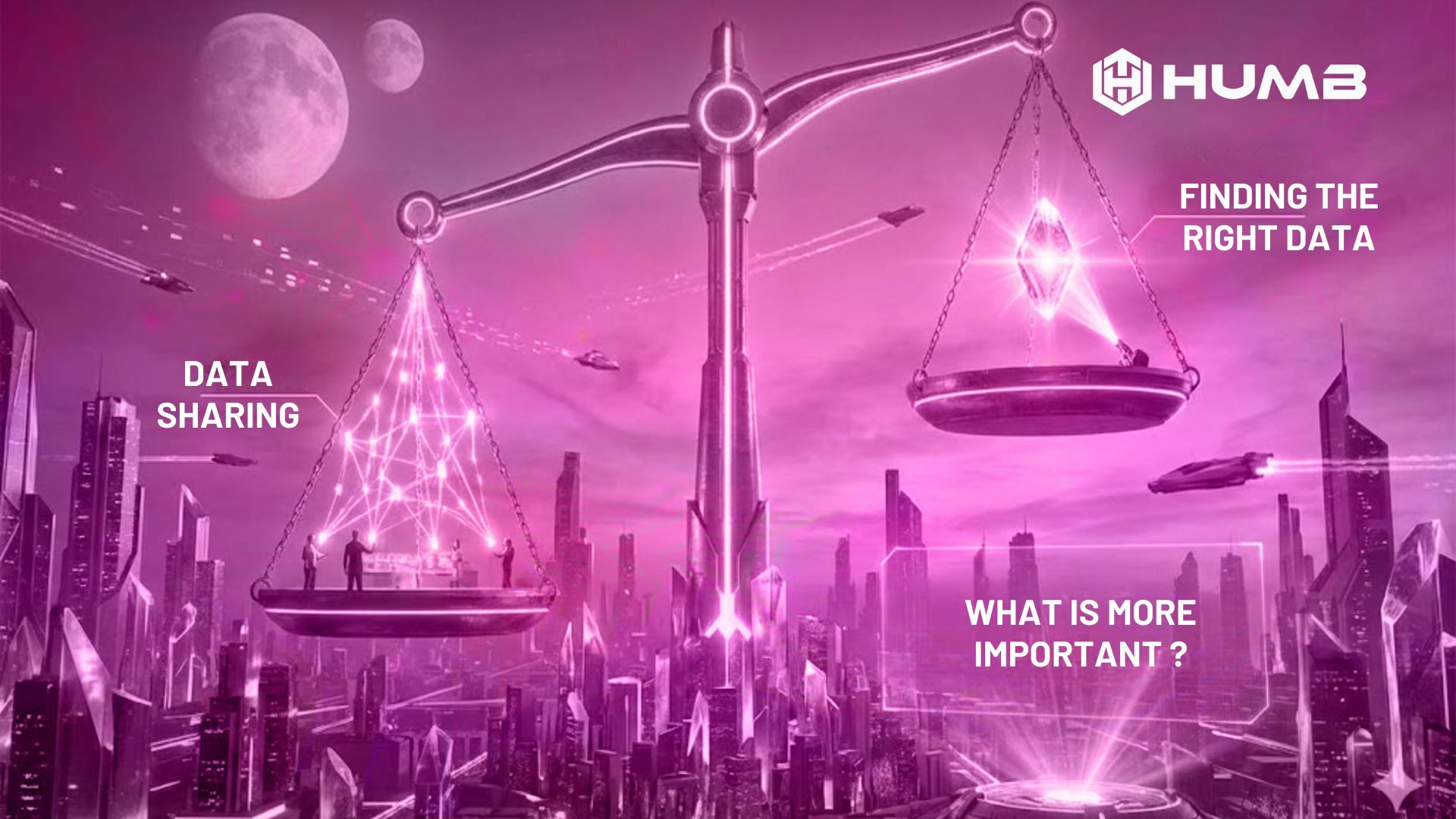
Which is the Bigger Problem?
For Patients & Providers - Data Sharing is the bigger challenge. If records don’t move across hospitals, continuity of care suffers.
For Researchers, AI, and Pharma - Finding the Right Data is the bigger issue. Even with access, the usable dataset is often poor.
Statistical Snapshot:
A 2023 HIMSS survey found 55% of healthcare executives cite interoperability / data sharing as their #1 challenge.
Meanwhile, McKinsey reported that clinicians spend 35–50% of their time searching for information showing that “finding the right data” is equally crippling.
Both problems are deeply linked. Data sharing is the foundational issue (if data isn’t shared, you can’t even look for it). But once shared, finding the right, high-quality, contextually relevant data is the harder practical challenge for actual use.
Tokenization can directly address both data sharing and finding the right data problems by combining blockchain’s trust layer with granular access and incentivization mechanisms. Here’s how:
1. Tokenization & Data Sharing
Tokenization turns patient data, health records, or datasets into unique digital tokens that can be securely tracked and exchanged.
Ownership & Consent: Patients hold tokens representing their data. Sharing happens only when they provide tokenized access → solving the “who controls data” problem.
Example: A patient could grant a research lab access to their oncology history via a data token, with an automatic expiry date.Regulatory Compliance: Smart contracts enforce HIPAA/GDPR rules automatically (e.g., consent expiration, anonymization), reducing the compliance burden on institutions.
Trust Layer for Collaboration: Hospitals, insurers, and researchers can interact via tokenized permissions instead of lengthy paper-based data sharing agreements.
Incentivization: Patients and providers can be rewarded in tokens for contributing their data to research or registries.
Impact: Speeds up interoperability, ensures security, and gives individuals more control.
2. Tokenization & Finding the Right Data
Once data is tokenized, it can be indexed, tagged, and traded in a structured way.
Metadata Tagging: Each tokenized record can carry metadata (age, condition, treatment type) → making discovery easier without exposing raw data.
Marketplace for Data: Researchers can query tokenized datasets to find the exact cohort they need, paying only for relevant subsets.
Example: A pharma company looking for 2,000 anonymized diabetic patient records can filter tokenized datasets by parameters, instead of sifting through millions of irrelevant files.Data Provenance: Blockchain immutability ensures the origin and quality of data can be verified → reducing errors and duplicates.
AI/ML Enablement: Clean, structured, and tokenized data improves model training by ensuring datasets are standardized and discoverable.
Impact: Turns healthcare data from a messy haystack into a structured, searchable, and reliable ecosystem.
Case Analogy:
Today: A researcher wants cardiovascular patient data, requests access and waits weeks/months for approvals. Finally gets incomplete or poor-quality data.
With Tokenization: Researcher queries a tokenized healthcare data marketplace on HUMB Exchange, finds matching tokens. Smart contract grants access, payment + compliance is automated and data is delivered in hours, not months.
Role of HUMB Exchange -
HUMB isn’t just another exchange. It is the smart bridge between healthcare data producers, tokenized data owners and researchers who desperately need high-quality, consented, reliable data.
HUMB Exchange serves as the smart bridge that makes tokenized data sharing actually work.
If we are able to standardize healthcare data, secure it through tokenization and enable permissioned access via compliant smart contracts, imagine what a confidence boost it will be for individuals, hospitals and researchers looking to share high-quality data.
If we are able to transform fragmented records into discoverable, ethically governed datasets while rewarding contributors and giving researchers a clear path to the “right data” they need
data sharing can turn into a seamless, secure, and value-driven experience for the entire healthcare ecosystem.
Summary:
In the end, “Data Sharing and Finding the Right Data” comes down to trust, clarity, and incentives with tokenization delivering all three. By turning healthcare data into permissioned, traceable and value-backed digital assets, tokenization makes it easier for individuals and institutions to share data responsibly while helping researchers quickly discover the high-quality datasets they need. It transforms data from a locked, fragmented resource into a governed, consent-driven ecosystem where everyone benefits especially the patients whose stories power the science of tomorrow.