


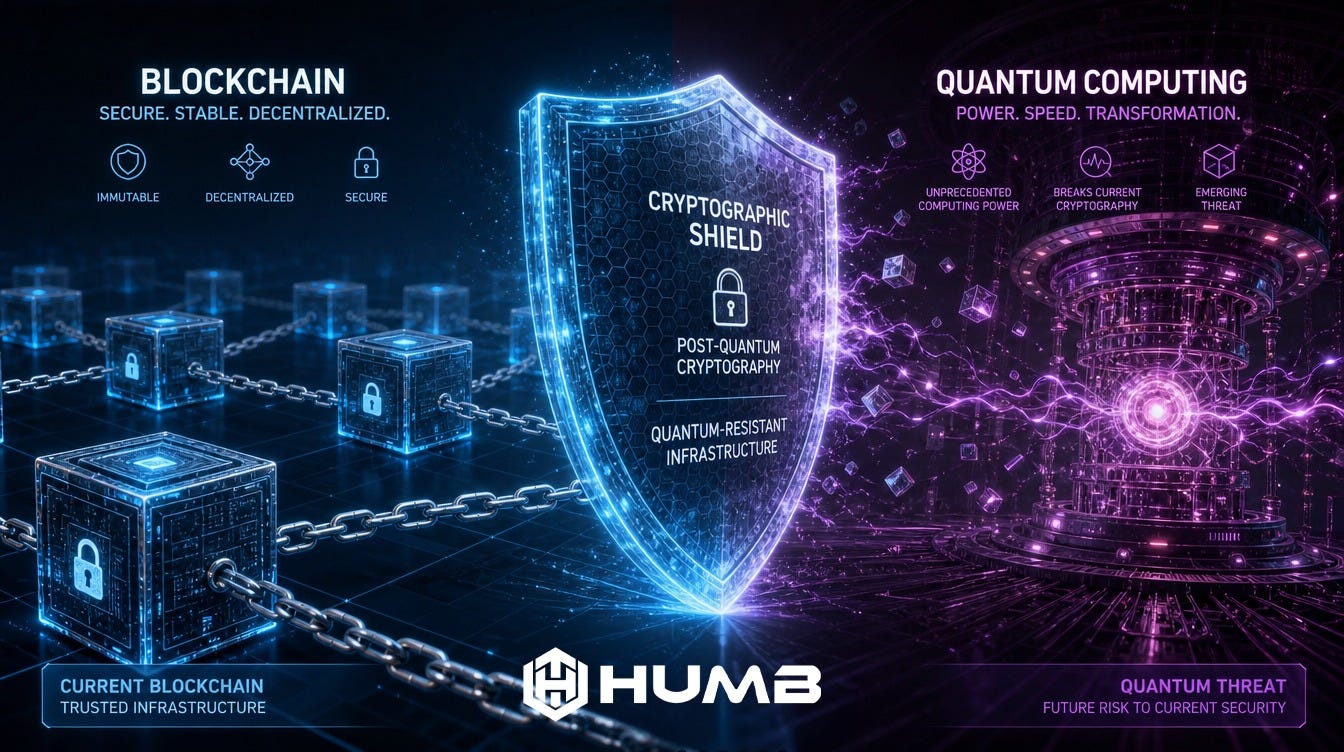
Cryptographic signatures protect wallets. Hash functions help secure blockchain data. Public and private keys allow users to prove ownership and authorise transactions.
For years, these mathematical foundations have provided extremely strong protection against conventional computers.
But computing itself is evolving.
Quantum computing promises to solve certain types of problems in fundamentally different ways from today’s machines. If sufficiently powerful, fault-tolerant quantum computers eventually arrive, some of the public-key cryptography used across banking, internet infrastructure-and blockchain networks-could become vulnerable.
That raises an important question for the digital-asset industry:
Is blockchain ready for the quantum era?
The short answer is:
Not completely-but preparation has already started.
And that may ultimately make blockchain infrastructure stronger.
First: What Makes Quantum Computing Different?
Traditional computers process information using bits:
0 or 1
Quantum computers use qubits, which can exploit quantum phenomena such as superposition and entanglement.
This does not mean quantum computers are simply “much faster computers.”
They are better suited to solving certain categories of mathematical problems.
For cryptography, one algorithm matters particularly:
Shor’s algorithm.
A sufficiently capable quantum computer running Shor’s algorithm could solve mathematical problems underlying widely used public-key cryptography, including RSA and elliptic-curve cryptography.
That matters because elliptic-curve cryptography plays an important role in many blockchain systems.
Google Quantum AI researchers published updated estimates in 2026 suggesting that breaking a 256-bit elliptic-curve discrete logarithm-the type of mathematical problem used in major cryptocurrencies-could theoretically be accomplished using fewer than roughly 1,200–1,450 logical qubits, depending on the circuit design.
That does not mean today’s quantum computers can attack Bitcoin, Ethereum or other major blockchains.
They cannot.
The distinction between today’s physical qubits and stable, error-corrected logical qubits is extremely important. Building a cryptographically relevant quantum computer remains a major scientific and engineering challenge.
But the direction of travel is clear enough that security organisations are preparing now.
Quantum Risk Does Not Mean “Blockchain Is Broken”
This is where discussions about quantum computing and crypto often become misleading.
Headlines sometimes suggest:
“Quantum computers will break blockchain.”
That is an oversimplification.
A blockchain contains several different cryptographic mechanisms.
Quantum computing affects them differently.
The most important distinction is between:
Digital signatures
and
Cryptographic hash functions.
1. Digital Signatures Face the Bigger Challenge
Digital signatures allow a blockchain user to demonstrate:
“I control the private key associated with this account, so I am authorised to move these assets.”
Many blockchain systems use elliptic-curve-based signature schemes.
For example, Bitcoin’s cryptographic transaction infrastructure uses secp256k1 elliptic-curve keys, while standard Ethereum externally owned accounts use ECDSA signatures based on secp256k1.
These systems are exceptionally secure against classical computers.
A sufficiently powerful quantum computer running Shor’s algorithm changes that equation.
If an attacker obtains a public key and has access to a cryptographically relevant quantum computer, the underlying private key could potentially become recoverable.
And if someone obtains your private key, they may be able to authorise transactions as though they were you.
That is the core quantum-security challenge for many cryptocurrencies.
2. Hash Functions Are a Different Story
Blockchain systems also depend heavily on cryptographic hashes.
Hash functions help protect transaction data, addresses, blocks and other parts of blockchain architecture.
Quantum computing affects hashes differently from elliptic-curve signatures.
Grover’s algorithm can theoretically accelerate certain brute-force searches against symmetric cryptography and hash functions, but the improvement is much less dramatic than the impact of Shor’s algorithm on public-key cryptography.
NIST notes that the practical advantage of Grover’s algorithm may be significantly constrained by factors such as serial computation requirements and the cost of quantum hardware.
So a future quantum computer would not simply switch on and instantly rewrite an entire blockchain.
The problem is more specific.
For many networks, the priority is upgrading the cryptographic mechanisms used to prove ownership and authorise transactions.
Are Crypto Wallets Vulnerable Today?
No cryptographically relevant quantum computer capable of breaking major blockchain signature systems is known to exist today.
Ethereum’s current quantum-security guidance explicitly states that no quantum computer today can break Ethereum’s cryptography.
So this is not a reason for crypto users to panic.
But there is an important architectural issue:
Public-key exposure.
A blockchain address and a public key are not always exactly the same thing.
Some blockchain designs initially expose a hash of a public key, while the actual public key becomes visible when funds are spent.
For example, traditional Bitcoin Pay-to-Public-Key-Hash transactions reveal the complete public key when the output is spent.
Ethereum similarly notes that standard accounts that have already sent transactions have exposed enough public-key information to become relevant in a future quantum-threat scenario.
This is one reason researchers are considering migration strategies before cryptographically relevant quantum computers arrive.
Security transitions take time.
Blockchains cannot wait until the day quantum attacks become practical and then begin planning.
The World Is Already Moving Toward Post-Quantum Cryptography
Blockchain is not alone in confronting this issue.
Banks.
Governments.
Cloud infrastructure.
Telecommunications.
Identity systems.
Cybersecurity platforms.
Almost every modern digital system relies on public-key cryptography somewhere.
That is why the U.S. National Institute of Standards and Technology-NIST-has spent years developing and evaluating post-quantum cryptography (PQC).
Post-quantum cryptography refers to cryptographic algorithms designed to remain secure against both conventional and future quantum computers.
In August 2024, NIST finalised its first three major post-quantum cryptography standards:
FIPS 203 - ML-KEM Designed primarily for establishing secure encryption keys.
FIPS 204 - ML-DSA A post-quantum digital-signature standard.
FIPS 205 - SLH-DSA A hash-based digital-signature standard.
And the message from NIST today is increasingly clear:
Organisations should begin migration planning now.
NIST’s current guidance says the first standards are ready for implementation and that organisations using public-key cryptography should begin identifying vulnerable systems and planning their transition.
Its transition strategy aims to deprecate and eventually remove quantum-vulnerable algorithms from relevant standards by 2035, with higher-risk systems expected to transition earlier.
If governments and global technology infrastructure are preparing, blockchain ecosystems need to think about the same transition.
Why Blockchain Migration Is More Complicated
Why not simply replace today’s signature algorithm with a post-quantum one?
Because blockchain networks operate under unusual constraints.
A conventional company can update software across infrastructure it controls.
A decentralised blockchain may involve:
Millions of wallets
Thousands of nodes
Independent developers
Hardware wallets
Smart contracts
Validators or miners
Exchanges and custodians
Layer-2 networks
Applications built over many years
And perhaps most importantly:
Users who may not actively monitor protocol upgrades.
That creates several difficult questions.
Challenge 1: Post-Quantum Signatures Can Be Larger
One advantage of today’s elliptic-curve cryptography is efficiency.
Keys and signatures can remain relatively compact.
Some quantum-resistant signature schemes require significantly larger keys or signatures.
For a blockchain where thousands of transactions must be distributed, verified and stored across many machines, additional data matters.
Larger signatures can potentially mean:
More bandwidth
More storage
Higher verification costs
Changes to block capacity
Different hardware requirements
Ethereum, for example, is researching how hash-based quantum-resistant validator signatures could be efficiently aggregated rather than simply replacing today’s compact BLS signatures one-for-one.
Post-quantum security therefore isn’t only a cryptography problem.
It is also an engineering problem.
Challenge 2: Millions of Existing Wallets May Need Migration
Creating a quantum-resistant wallet for new users is one problem.
Protecting years of existing assets is another.
A blockchain could introduce a new quantum-resistant address or signature format.
But what happens to assets sitting in older wallets?
Users may need a secure migration path.
Exchanges may need wallet upgrades.
Custodians may need to rotate keys.
Hardware-wallet manufacturers may require firmware or hardware changes.
Institutions may need new custody procedures.
And some wallets may belong to users who have lost access or are no longer active.
This makes quantum migration partly a coordination challenge.
Challenge 3: Decentralised Networks Need Consensus
Major blockchain upgrades cannot always be imposed by one organisation.
Network participants need to agree on how new cryptographic rules will work.
Developers must design them.
Implementations must be tested.
Wallets must support them.
Infrastructure providers must integrate them.
Users must migrate.
And network rules may require soft forks, hard forks or other protocol-level changes.
That process takes time-which is precisely why early preparation matters.
Blockchain Developers Are Already Working on the Problem
The encouraging news is that post-quantum blockchain security is no longer purely theoretical.
Research and engineering are accelerating.
Ethereum
Ethereum has one of the clearest publicly documented efforts.
The Ethereum Foundation formed a dedicated Post-Quantum Security team in January 2026.
Current research covers multiple areas of Ethereum architecture, including:
account signatures;
validator signatures;
data-availability commitments; and
zero-knowledge proof systems.
Its roadmap explores hash-based signatures, post-quantum-compatible commitments and account abstraction that could eventually allow individual users to migrate toward quantum-resistant signature systems.
Ethereum’s current planning milestones target core post-quantum infrastructure around 2029, although these remain development targets rather than guaranteed deadlines.
That is important.
It shows that a leading blockchain ecosystem is treating quantum resistance as a long-term engineering requirement rather than waiting for a crisis.
Bitcoin
The Bitcoin development community is also actively discussing possible quantum-resistant strategies.
Current discussions include ways to protect outputs whose public keys have not yet been exposed and proposals for output structures that could incorporate post-quantum spending paths.
Bitcoin Optech has been documenting ongoing developer discussions around quantum-safe migration and the trade-offs involved.
Bitcoin’s decentralised governance makes major cryptographic transitions necessarily careful.
But careful is not the same as inactive.
Research happening years before an immediate threat is exactly what resilient infrastructure should look like.
Could Post-Quantum Cryptography Create a Stronger Blockchain Industry?
This is where the conversation becomes much more positive.
Quantum computing is usually framed as a threat.
But security pressure has historically driven technology forward.
The internet continuously upgraded encryption.
Payment networks improved authentication.
Banks moved from older cryptographic standards to stronger ones.
Cloud systems constantly rotate protocols and keys.
Blockchain should be no different.
Preparing for quantum computing could accelerate several valuable developments.
1. Cryptographic Agility
Future blockchain systems may become less dependent on one permanent cryptographic algorithm.
Instead, accounts could become cryptographically agile-capable of changing signature schemes when security standards evolve.
That could make blockchain infrastructure more adaptable to threats we have not even identified yet.
2. Smarter Wallet Architecture
Future wallets could automatically support:
Key rotation
Post-quantum signatures
Multiple authentication methods
Recovery mechanisms
Hardware-backed security
Flexible account permissions
Users may eventually interact with these systems without needing to understand the cryptography underneath them.
That would be a sign of maturity.
The strongest infrastructure often becomes invisible to the user.
3. More Research Into Blockchain Security
Quantum preparation is encouraging collaboration between:
Cryptographers
Blockchain developers
Quantum researchers
Cybersecurity specialists
Hardware manufacturers
Universities
Standards organisations
That cross-industry research could improve blockchain security even before large quantum computers become practical.
4. A New Standard for Institutional Digital Assets
Institutional adoption of digital assets requires long-term security thinking.
An organisation holding assets for decades must ask different questions from a short-term trader.
Can the custody system survive future cryptographic change?
Can keys be rotated safely?
Can protocols upgrade without losing asset ownership?
Are smart contracts dependent on vulnerable cryptography?
Post-quantum readiness could eventually become part of institutional blockchain due diligence.
What Should Crypto Traders and Enthusiasts Do Today?
For most users:
Don’t panic.
There is currently no known quantum computer capable of breaking the cryptographic security of Bitcoin or Ethereum.
Selling crypto because “quantum computing is coming” would misunderstand both the current technology and the migration work already underway.
Instead, traders and long-term participants should pay attention to the industry’s development.
Watch for:
Post-quantum wallet standards
New signature schemes
Blockchain upgrade proposals
Hardware-wallet support
Exchange and custody migration plans
NIST cryptographic standards
Progress in fault-tolerant quantum computing
Protocol-level quantum-security roadmaps
The important word is:
Preparation.
Quantum security is not today’s emergency.
It is tomorrow’s engineering requirement.
There Is Another Important Lesson: Never Stop Upgrading Security
One particularly interesting event occurred in July 2026.
A post-quantum signature candidate called HAWK, which was being evaluated in NIST’s additional digital-signature process, was withdrawn after researchers identified a mathematical vulnerability.
NIST clarified that this issue did not affect its already-finalised standards such as ML-KEM and ML-DSA.
Rather than being evidence that post-quantum cryptography is failing, this demonstrates something important about cryptographic security:
Strong algorithms become strong through aggressive testing.
Cryptographers attack them.
Researchers challenge assumptions.
Weak candidates are removed.
Standards evolve.
Security is not created by declaring an algorithm safe.
It is strengthened through continuous scrutiny.
Blockchain must embrace the same mindset.
So, Is Blockchain Ready for the Quantum Era?
Not completely.
Neither is much of the world’s existing digital infrastructure.
But that is not the same as being unprepared.
The foundations for the transition are already emerging.
NIST has standardised post-quantum algorithms.
Technology companies are establishing migration timelines.
Cryptographers are improving estimates of quantum attack requirements.
Ethereum has established dedicated post-quantum research.
Bitcoin developers are discussing migration mechanisms.
Security researchers are testing new signature systems.
The work has begun.
And importantly:
We still have time to get it right.
The Bigger Picture
Blockchain was never valuable because one cryptographic algorithm would remain secure forever.
Its deeper strength lies in the ability of open networks, developers and cryptographers to adapt while preserving verifiable ownership and consensus.
The quantum era may eventually force blockchain networks to change some of their foundations.
But evolving cryptography does not mean abandoning blockchain.
It means upgrading it.
We have already seen blockchain technology evolve through:
New consensus mechanisms
Layer-2 networks
Zero-knowledge proofs
Account abstraction
Advanced custody
Hardware wallets
Improved privacy technology
Post-quantum security may simply become the next chapter.
Final Thought
The wrong question is:
“Will quantum computing destroy blockchain?”
A better question is:
“Can blockchain upgrade its cryptography before quantum computing becomes a real threat?”
Today, the evidence suggests the industry understands that challenge-and serious preparation is underway.
Quantum computers are not breaking crypto today.
But future-ready blockchain infrastructure will need to be secure not only against the computers we have now…
but against the computers we haven’t built yet.
And that is what makes post-quantum cryptography one of the most important long-term technology stories for blockchain to watch.
What do you think: Will quantum resistance become a standard blockchain feature before cryptographically relevant quantum computers arrive?
Share your perspective in the comments.
This article is for educational and informational purposes only and does not constitute financial, investment, cybersecurity or trading advice.
#Blockchain #QuantumComputing #PostQuantumCryptography #PQC #Bitcoin #Ethereum #Crypto #Cryptocurrency #Cybersecurity #DigitalAssets #BlockchainSecurity #Cryptography #Web3 #FutureOfFinance #FinTech #HUMBExchange