



October 2026: The Macro Calendar That Could Decide Bitcoin’s Next Move
“Uptober” has history on its side-but CPI, the Federal Reserve and inflation data may matter far more than the calendar this month.
October has one of the strongest reputations in crypto.
Between 2013 and 2025, Bitcoin finished October higher in 10 of 13 years. Depending on the market-data methodology used, its average October return over that period is around 19%. That historical strength is exactly why traders call the month “Uptober.”
But 2025 delivered an important reminder: Bitcoin reached a record high during October yet ultimately finished the month roughly 4% lower. Seasonality can influence expectations, but it cannot override macro conditions, leverage, liquidity or changing investor positioning.
And October 2026 may provide another major test of the Uptober narrative.
Why Macro Matters More This October
The backdrop is already unusual.
At its September 16 meeting, the Federal Reserve raised the federal funds target range by 25 basis points to 3.75%-4.00%, while stating that inflation remained elevated.
Then, on October 2, the U.S. employment report showed just 29,000 additional nonfarm payrolls in September, while unemployment stood at 4.2%.
Bitcoin responded quickly to the shifting rate narrative. By October 5, BTC had pushed close to $87,000 as softer labor data reduced some concerns about further monetary tightening, although the move subsequently pulled back.
That reaction tells traders something important:
Bitcoin is entering Uptober with macro sensitivity still very much alive.
The Key October 2026 Dates Bitcoin Traders Should Watch
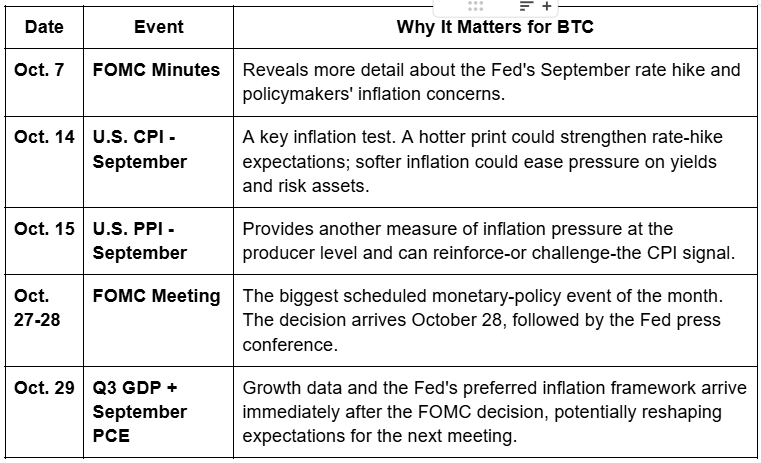
The Federal Reserve has officially scheduled the September-meeting minutes for October 7 and its next two-day FOMC meeting for October 27-28.
The Bureau of Labor Statistics confirms September CPI for October 14 and PPI for October 15.
And the Bureau of Economic Analysis has scheduled both the advance Q3 GDP estimate and September Personal Income and Outlays for October 29.
That creates a particularly interesting setup: the Federal Reserve will make its October decision one day before the next public PCE inflation and Q3 GDP releases.
CPI Could Be the First Major Test
For crypto traders, October 14 may be one of the most important days before the Fed meeting.
Inflation data can influence Treasury yields, the U.S. dollar and expectations for Federal Reserve policy-all of which can affect demand for risk assets such as Bitcoin.
The relationship is not mechanical.
A lower-than-expected CPI does not automatically mean Bitcoin rises, just as hotter inflation does not guarantee a sell-off. ETF flows, positioning, leverage and broader risk sentiment can amplify or offset the macro reaction.
Recent market action illustrates this clearly. CoinDesk reported that softer inflation previously pushed Bitcoin above $85,000, but the rally faded as long-term Treasury yields remained elevated.
The data matters-but so does the market’s reaction to the data.
October 28: The Main Event
Then comes the Federal Reserve decision on October 28.
Markets will be watching not only whether policymakers change rates, but also the language of the statement and the signals from the press conference.
For Bitcoin, the difference between a more hawkish and a more patient Fed could influence:
Treasury yields • U.S. dollar strength • liquidity expectations • institutional risk appetite • ETF demand • crypto leverage
Coinbase Institutional has repeatedly highlighted the connection between higher real yields, monetary policy and Bitcoin’s broader liquidity environment.
That makes the October FOMC meeting much more relevant than simply asking whether Bitcoin has historically performed well during this month.
Beyond the Fed: Watch the Crypto-Specific Signals
Macro will not determine Bitcoin’s direction alone.
ETF demand remains an important part of the market structure. CryptoQuant recently reported that U.S. spot Bitcoin ETF demand had turned positive for 2026 after substantial accumulation since the July lows.
At the same time, traders should continue monitoring spot demand, ETF flows, funding rates, open interest, liquidations and whale activity.
A bullish macro surprise combined with genuine spot demand is very different from a rally driven primarily by leverage.
That distinction matters.
So, Will Uptober Deliver?
History gives the bulls something to work with.
But history does not make October bullish by default.
The more important question for 2026 is whether the macro environment and crypto market structure confirm the seasonal narrative.
October 7: What was the Fed really thinking?
October 14-15: Is inflation cooling or accelerating?
October 28: What will the Fed do next?
October 29: What do GDP and PCE reveal after the decision?
These events could repeatedly reset expectations throughout the month.
The HUMB Takeaway
Uptober is a historical pattern-not a trading signal.
The calendar may give Bitcoin a bullish reputation.
But this October, traders should watch the data behind the narrative.
History creates expectations.
Macro changes expectations.
Price confirms-or rejects-the story.
At HUMB Exchange, we believe informed trading starts with understanding the forces behind market movement-not simply following the narrative.
Watch the data. Respect the volatility. Manage the risk.
Disclaimer: This article is for educational and informational purposes only and does not constitute financial, investment or trading advice. Historical performance does not guarantee future results. Cryptocurrency markets involve significant risk.