


If you’re a trader, let me ask you something honestly - how many tokens have you seen rise on momentum… and then quietly disappear once the attention moved on?
Now flip that question.
What happens when a token isn’t dependent on attention at all?
What happens when its demand comes from systems that need to function regardless of market sentiment?
Over the past year, as one of the co-founders of HUMB Exchange, I’ve been asked a deceptively simple question: “What really gives a utility token value?”
I’ve heard it from traders chasing momentum, from skeptics questioning sustainability and from serious builders trying to understand where this industry is heading.
What strikes me most is not the question itself but the paradox behind it - Billions flow into tokens driven purely by hype, but many pause when confronted with tokens designed around real-world function.
That contrast says more about market psychology than it does about token design.
I have seen many investors willingly deploy capital into tokens with no defined economic purpose and yet hesitate when evaluating tokens built around real-world function.
And it’s exactly why this conversation matters now. Because the real story of crypto is unfolding in the tension between excitement and endurance.
But before we attempt to answer that, we need to step back and understand something fundamental: There are two very different species of tokens.
I call it the battle of UTILITY vs HYPE.
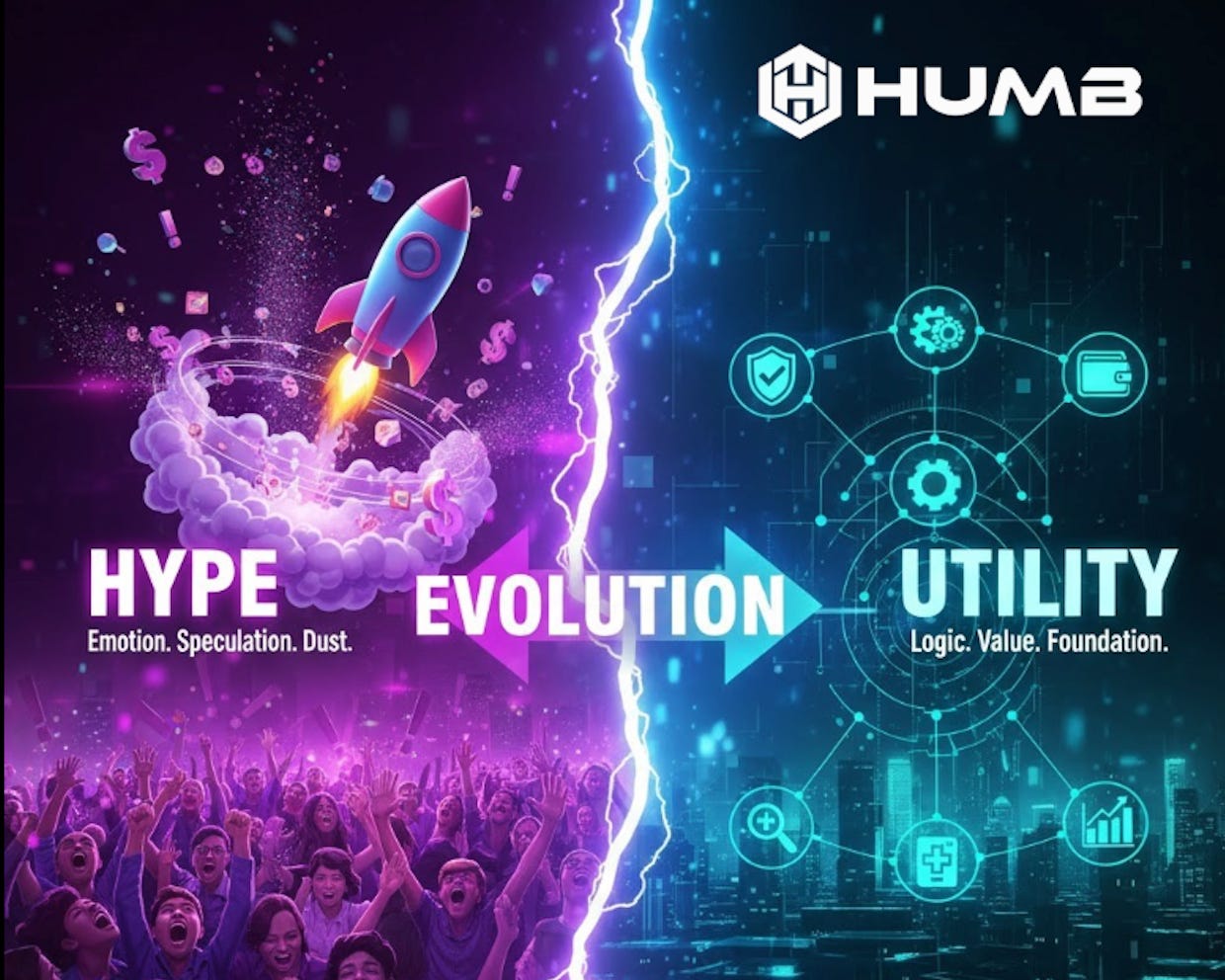
DON’T CONFUSE PAINT WITH FOUNDATION
You must have heard the phrase don’t confuse paint with foundation.
Paint catches the eye and makes the house look attractive. But the foundation is what keeps the house standing when the weather turns.
In digital asset markets, hype is the paint and utility is the foundation. And this distinction matters especially in healthcare, where systems must endure beyond cycles.
How I Evaluate a Token - Hype Vs Utility
When I look at a token, I don’t start with the chart. I start with demand drivers.
If the dominant signals are:
Social media virality
Influencer amplification
Scarcity narratives
Short-term liquidity waves
FOMO cycles
Then what we are likely looking at is an attention-driven hype token. Here, price appreciation becomes the primary narrative. Demand is speculative, Liquidity is reflexive and Volatility is structural. When attention fades, value often weakens because attention was the value proposition.
Now compare that with tokens where the dominant drivers are:
Embedded use within a working ecosystem
Required access to services, governance, or settlement
Measurable adoption metrics
Transactional relevance
Structural, recurring demand
This signals a usage-driven utility token.
Here, users do not buy because it is trending. They use it because it is required. Demand is generated by participation, Adoption compounds value and Integration creates durability.
And if you look beyond narratives and into the data, the pattern becomes even clearer
The Data on Meme & Hype Token Failure Rates
The fascination with hype tokens is understandable as they can generate dramatic short-term returns. But the survival statistics are sobering.
A Binance Research report (2023) found that approximately 97% of meme tokens launched during peak cycles eventually saw trading volumes collapse to near zero, effectively becoming inactive.
CoinMarketCap lifecycle tracking shows that a significant majority of newly launched tokens fail within the first year, particularly those without sustained ecosystem integration.
Chainalysis reports repeatedly highlight that a large percentage of rapid-launch tokens fall into “low-liquidity abandonment” or short-lived trading patterns, especially in speculative cycles.
Academic research on token markets (e.g., Cong et al., 2021, Review of Financial Studies) suggests that tokens lacking economic function exhibit higher volatility and lower long-term persistence.
These numbers do not imply that every meme token fails but they do illustrate that purely narrative-driven assets have extremely high mortality rates. My analysis shows that a small number of meme tokens that survived had shifted from pure hype toward community infrastructure, ecosystem expansion or embedded utility.
Behavioral finance research consistently shows that retail participants are drawn toward high-volatility assets due to overconfidence bias and herd dynamics (Barber & Odean, 2000). The emotional payoff of rapid movement often outweighs the rational appeal of structural design.
As traders, we’re conditioned to chase movement. As builders, we’re forced to understand what sustains it.
Bridging that gap, here’s my perspective on how real value gets created in utility tokens.
What Actually Drives Utility Token Value?
From my perspective five structural drivers determine whether a utility token can sustain value:
1. Embedded Economic Function
At the core, the first question I ask is simple: is the token actually required for the ecosystem to function? The moment a token becomes essential to activity, whether it’s used for fee reductions, enabling governance participation, granting access permissions or acting as a medium for transactional settlement, it begins to generate natural, recurring demand. In such cases, the token is no longer a speculative add-on; it becomes embedded into the operational fabric of the platform, ensuring that usage is not just sentiment but drives its value.
If the token is not required for ecosystem activity, its utility weakens.
2. Embedded Demand (Integration Depth)
The second lens I apply is embedded demand. Whether there is a natural, unavoidable reason for users to interact with the token. The strongest utility tokens are woven directly into the core flows of the ecosystem: they power platform transactions, unlock access to services, drive incentive structures and enable participation models. When a token sits at the center of these interactions, demand becomes organic and recurring, arising from actual usage rather than market speculation. Over time, this kind of embedded demand creates a far more resilient and predictable value foundation.
Utility strengthens when the token is woven into everyday user actions, not isolated from them.
3. Measurable Adoption
The third lens is adoption metrics because true utility must be measurable. A strong utility token doesn’t rely on narratives alone; it demonstrates clear, trackable signals of growth. You see it in increasing active users, rising transaction volumes, expanding ecosystem integrations, and liquidity that is sustained by usage rather than spikes. Narratives will always fluctuate with market sentiment, but metrics provide a far more reliable indicator of whether real value is being created and sustained.
Narratives may drive interest, but only metrics validate real value creation.
4. Sector Longevity
The fourth lens is the longevity of the underlying sector. A token anchored to a fleeting trend will behave very differently from one embedded in a structural, multi-decade industry. The durability of the sector directly influences the durability of the token’s demand. Healthcare, for instance, is not a short-cycle narrative that rises and falls with sentiment. It is a fundamental layer of global infrastructure. When a token is aligned with such enduring sectors, its value proposition extends beyond market cycles and into long-term relevance.
Tokens anchored to enduring industries inherit the staying power of the sector itself.
5. Responsible Token Design
The fifth lens is responsible design. I have seen a strong utility fail if the underlying tokenomics is poorly structured. Supply mechanics, fair and transparent distribution, regulatory awareness and alignment with the broader ecosystem all play a critical role in determining long-term viability. A token must be engineered with intention, balancing incentives across stakeholders while ensuring sustainability and compliance. Without this discipline, even a well-positioned utility token can struggle to translate potential into durable value.
Utility creates potential but disciplined tokenomics determine whether that potential survives.
The Larger Market Transition
Crypto is entering a new phase that feels subtle on the surface but is fundamentally changing how value is evaluated. For a long time, the dominant question in the market was simple: what will pump next? It was a momentum-driven mindset, where speed often mattered more than substance.
But that question is evolving. Increasingly, market participants are beginning to ask: what actually works? What delivers consistent value, sustains usage and integrates into real-world systems?
Haven’t we seen this pattern play out across every major technological cycle. The early internet rewarded eyeballs before it rewarded business models. Mobile apps chased downloads before monetization. AI saw waves of experimentation before real enterprise adoption emerged.
Crypto is following the same trajectory. The hype phase builds attention, but the consolidation phase builds lasting value.
Why HUMB Is Focused on Utility-Driven Healthcare Tokens
That’s the lens we operate with at HUMB.
Healthcare is not a short-cycle narrative. It is a multi-trillion-dollar global infrastructure system that operates every single day, across geographies, regulations and use cases.
We made a deliberate choice early on: not to build around speculative cycles, but to build where demand is inevitable.
We are integrating tokens into healthcare-aligned ecosystems where usage is tied to real participation, not just market positioning.
We are not in the business of just listing tokens. We are in the business of enabling ecosystems.
Two examples currently available on HUMB:
$PRN, for instance. It is not positioned as just another tradable asset; it functions as the utility layer of the Pranachain blockchain an ecosystem purpose-built for healthcare-grade requirements. The more the infrastructure is used, the more the token becomes integral to its operation.
$EGBT. This is not abstract utility. EGBT is directly linked to real-world healthcare applications. As the utility token of Eastgate Biotech, $EGBT is designed to interface with innovative healthcare products and solutions, creating a bridge between tokenized value and tangible healthcare use cases.
This is precisely where it aligns with HUMB’s broader vision.
We are not building an exchange that simply lists tokens.
We are building an ecosystem that curates purpose-driven digital assets where each token has a defined role within a larger healthcare narrative.
For traders, this introduces a different dimension of value. You’re not just trading volatility, you’re gaining exposure to ecosystems that are solving structural problems.
For the broader market, it signals where things are heading.
As crypto matures, the winners will not be defined by how loudly they trend but by how deeply they integrate.
And at HUMB, integration is the strategy because honestly in my opinion in the long run, markets don’t reward what is exciting. They reward what is essential.
PranaChain - Is building healthcare-grade blockchain infrastructure and owns the $PRN token that drives the healthcare-grade blockchain ecosystem. $PRN token is exclusively listed on HUMB Exchange. For more details visit the PranaChain token page on HUMB Exchange
EastGate Biotech - Produces and distributes innovative and healthy nutraceuticals that are based on natural therapies and absorbed naturally by the body and owns the $EGBT token that drives the product usage ecosystem. $EGBT token is exclusively listed on HUMB Exchange. Visit EastGate Biotech website for more details
HUMB Exchange - Is a fully regulated and complaint Virtual Assets Service Provider (VASP). HUMB brings a unique blend of top main stream cryptocurrencies and innovation healthcare tokens to its users for traders. Register on HUMB Exchange to start your trading journey now.
About the Author: Vishwajeet Jathar is one of the co-founders of HUMB. He has coined the concept of Healthcare 6.0 as the next phase of evolution within the healthcare industry with HUMB Exchange as the enabler through tokenization, blockchain, incentivization and listing healthcare tokens. The views and opinions expressed in this article are his own and are intended for informational and educational purposes only. They do not necessarily reflect the official position, strategy, or views of the company, its affiliates, or partners. This content should not be construed as financial, investment, legal, or medical advice. Readers are encouraged to conduct their own research and seek independent professional guidance where appropriate. For more information about HUMB and its initiatives, please visit humb.io