


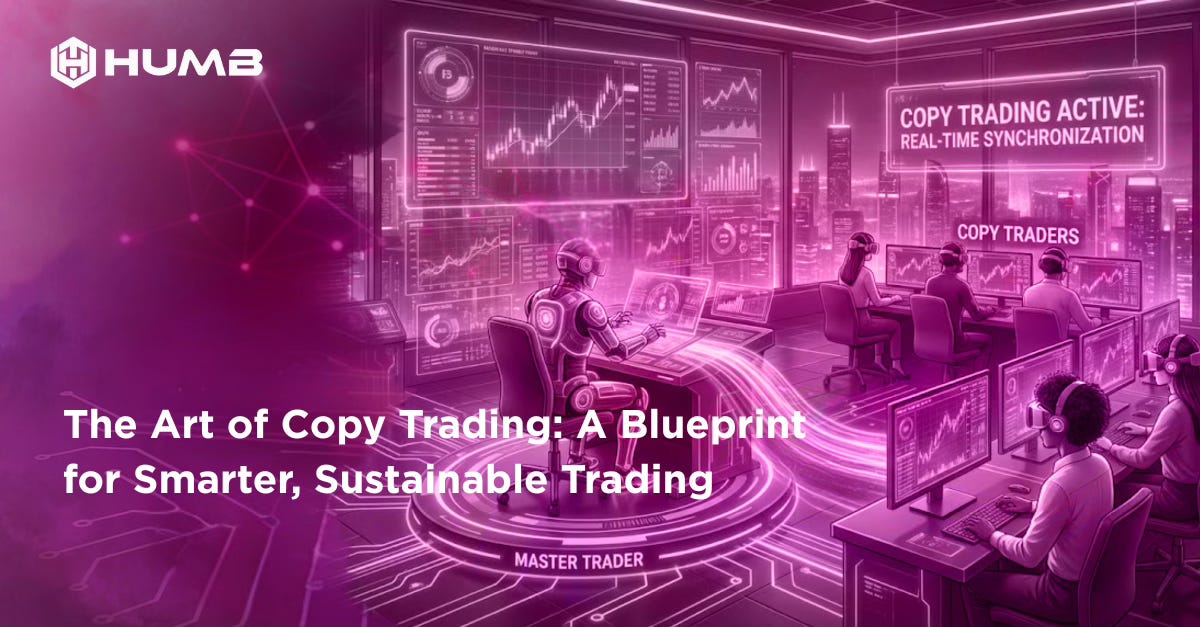
Copy trading is an innovative trading feature that allows less-experienced traders called as ”copy traders” to automatically replicate the trades of experienced traders called as ”master traders”. This means that whenever a master trader places a trade, the same trade is executed in the copy trader’s account proportionally. It removes the complexity of market analysis and enables new traders to benefit from the expertise of seasoned professionals. Retail traders today don’t just learn from professionals - they follow them. Copy trading has moved from being an experimental niche feature to a mainstream strategy, especially among newer traders who prefer outcome-based guidance rather than learning every technical detail themselves.
How Copy Trading Works (In Layman’s Terms)
A trader signs up on the exchange and opts for copy trading.
The trader selects a master trader based on their past performance, risk level and trading strategy.
The system automatically copies the master trader’s trades into the copy trader’s account in real-time.
If the master trader profits, the copy trader also profits proportionally; if there’s a loss, the copy trader incurs a similar loss.
The master trader earns a share of the copy trader’s profits as an incentive for being followed.
Benefits for Master Traders:
Earn Additional Revenue: Receive a commission or percentage of profits from copy traders.
Enhanced Reputation: Gain recognition as a top-performing trader.
Leverage Larger Capital: Influence more funds under management without additional investment.
Benefits for Copy Traders:
Access to Expertise: Benefit from professional traders’ insights and strategies.
Passive Trading: No need for in-depth market analysis or constant monitoring.
Learning Opportunity: Observe trading patterns and decision-making processes.
With Copy Trading, HUMB Exchange empowers traders of all experience levels, fosters a thriving trading environment and enhances user engagement. Whether you are an experienced trader looking to monetize your skills or a beginner seeking expert guidance, copy trading offers a win-win scenario for all participants in the ecosystem.
But here’s the truth: Copy trading is only as good as the master you follow.
Choosing the wrong profile can convert a profitable strategy into a slow bleed. Choosing correctly can offer institutional-quality exposure at a fraction of the effort. So what should a trader look at before following a master? Let’s break it down.
The Core Parameters That Matter When Selecting a Master Trader
Choosing a master trader is not about following the most profitable profile or the person with the flashiest ROI. It is about selecting someone whose risk behaviour, discipline and decision structure can safely be replicated.
These seven indicators are reliable predictors of long-term success and each one reflects a different dimension of trading quality.
1. Maximum Drawdown (MDD)
What it means: Maximum Drawdown measures the worst peak-to-trough decline in the trader’s portfolio. It tells you how much you would have lost by copying them at the wrong time.
Why it is an important indicator: Because profitability means nothing if a single mistake can wipe the account.
A trader with 300% ROI but 60% drawdown is far riskier than a trader with 40% ROI and 8% drawdown.
What good looks like:
Spot Copy Trading: < 10–12%
Futures Copy Trading: < 20–25%
Avoid: Anything above 30% (statistically dangerous)
Copy trading is not about chasing returns. It is about choosing someone who protects capital first.
2. Risk-Reward Ratio (RRR)
What it means: RRR tells you how much the trader gains on average compared to how much they lose.
Example: RR 2:1 means → for every $1 lost, $2 are gained.
Why it matters: A 90% win rate is meaningless if the 10% losses are catastrophic.
Most losing traders fail because they:
Let losers run
Cut winners too early
Have RR < 1
What good looks like:
Spot: ≥ 1.5 : 1
Futures: ≥ 2.0 : 1
Elite traders: maintain RR ≥ 2.5+
You don’t need to win often; you need to win mathematically.
3. Win Rate Stability (Not Just the %)
What it means: Win rate shows how often the trader’s trades close in profit.
Why stability matters: A 45–65% win rate with strong RR is healthier than a 90% win rate with terrible RR.
What good looks like:
Ideal zone: 45–65%
Anything >80% = red flag (likely small wins + big losses)
Anything <40% requires extremely high RR to be viable
A realistic, balanced win rate is the mark of a sustainable trader.
4. Consistency of returns (rolling 30/90 days)
What it means: Rolling returns measure how smooth or choppy the trader’s growth is across different time windows.
Why it matters: Spikes in ROI often mean:
Lucky entries
Hype trading
Overexposure
Unsustainable patterns
Smooth curves reflect:
Systematic processes
Controlled sizing
Reliable decision-making
What good looks like:
Upward-sloping equity curve
Low volatility between months
Avoid traders with U-shaped or highly jagged curves
Look for steadiness, not fireworks.
5. Position Sizing Discipline
What it means: Position sizing reflects how much of the account the trader risks per trade.
Why it matters: Poor position sizing is the #1 cause of account blow-ups, especially in futures.
Examples of harmful behaviour:
Martingale (doubling down on losses)
Randomly increasing size
Going all-in on conviction trades
Increasing size after emotional losses
What good looks like:
1–3% of equity risked per trade (spot)
0.5–2% of equity risked per trade (futures)
Scaling into strength, not weakness
Position sizing is the difference between a professional and a gambler.
6. Recovery Speed from Drawdowns
What it means: How long does it take the trader to recover from a losing streak?
Why it matters: Slow recoveries indicate:
Poor risk management
Bad win-loss math
Emotional hesitation
Lack of strategy adaptability
A trader who recovers too fast may be:
Over-leveraging
Averaging down
Taking oversized trades to “make it back”
What good looks like:
Clean recoveries within 2–3 weeks
No revenge trading patterns
No large, desperate trades following losses
Recovery behaviour reveals true trader psychology.
7. Transparency & Strategy Logic
What it means: Does the trader clearly explain -
Why they enter?
Why they exit?
How they manage losses?
What invalidates a trade?
Why it matters: Copy trading is about trusting a human strategy, not a mystery box. A trader who cannot articulate their method does not understand it.
What good looks like:
Clear reasoning
Honest loss explanations
Defined exit rules
No “I just had a feeling” traders
If you can’t understand their strategy, you shouldn’t follow it.
The Ideal Master Trader Has…
Low drawdown
High RR
Moderate (not extreme) win rate
Smooth and steady returns
Controlled position sizing
Quick but rational recoveries
Clear strategy logic
This is the master trader profile that statistically outperforms over time.
How Parameters Change Between Spot vs. Futures Copy Trading
There is a difference—an important one.
Spot Copy Trading Priorities
Top Drivers:
Risk exposure per trade
Diversification of assets
Longer holding windows
Predictable cost basis
Market direction alignment
Spot traders are better evaluated on:
Portfolio return consistency
Hedging strategy
Accumulation discipline
Low drawdown swings
Time-to-recovery
Spot masters must show financial maturity and not just trading ability.
Futures Copy Trading Priorities
Here, execution quality matters most. You want a master who is:
Emotion-resistant
Quick with exits
Tight with Stop Loss (SL) management
Aggressive but systematic
Futures masters should demonstrate:
Leverage discipline
Strict liquidation safeguards
High RR ratios
Controlled pyramiding
Short exposure competency (shorting is not optional)
One poor decision can wipe both traders.
The Golden Rule
A good master for Spot is often a strategic accumulator.
A good Futures master is often a tactical risk-manager.
Final Thoughts
Copy trading can dramatically improve a trader’s outcomes - but only when you follow the right master.
Don’t get hypnotized by flashy ROI or screenshots. Look at what really matters: Risk, discipline, consistency and recovery.
Your goal isn’t to copy someone who wins a lot. Your goal is to copy someone who wins responsibly.
Because in copy trading - you don’t just mirror their profits, you mirror their mistakes too.
Choose wisely. Copy intelligently. Trade with structure.
Disclaimer:- The views expressed in this article are the author’s own and are shared for educational purposes only. Nothing here should be interpreted as financial, investment or trading advice. Copy trading involves significant risk and past performance of any trader or strategy is not a guarantee of future results. Readers should conduct their own research and consider their personal financial situation before making any trading decisions.