


The year 2025 marked a turning point for both the crypto industry and digital healthcare. What were once fast-moving, experimental domains began to mature into structured, regulated ecosystems with real-world consequences.
For crypto, this meant a shift away from hype toward institutional participation, regulatory clarity and infrastructure-grade security. For digital healthcare, it meant accelerated progress in data interoperability, AI governance and cross-border health information exchange.
This article highlights the key events that we at HUMB feel shaped 2025 across both industries explained in simple terms more so for healthcare stakeholders. We also look forward to 2026, outlining how these trends are converging to unlock new models for patient engagement, outcome-based incentives and trusted digital health ecosystems and what this evolution means for platforms like HUMB at the intersection of healthcare and compliant digital assets.
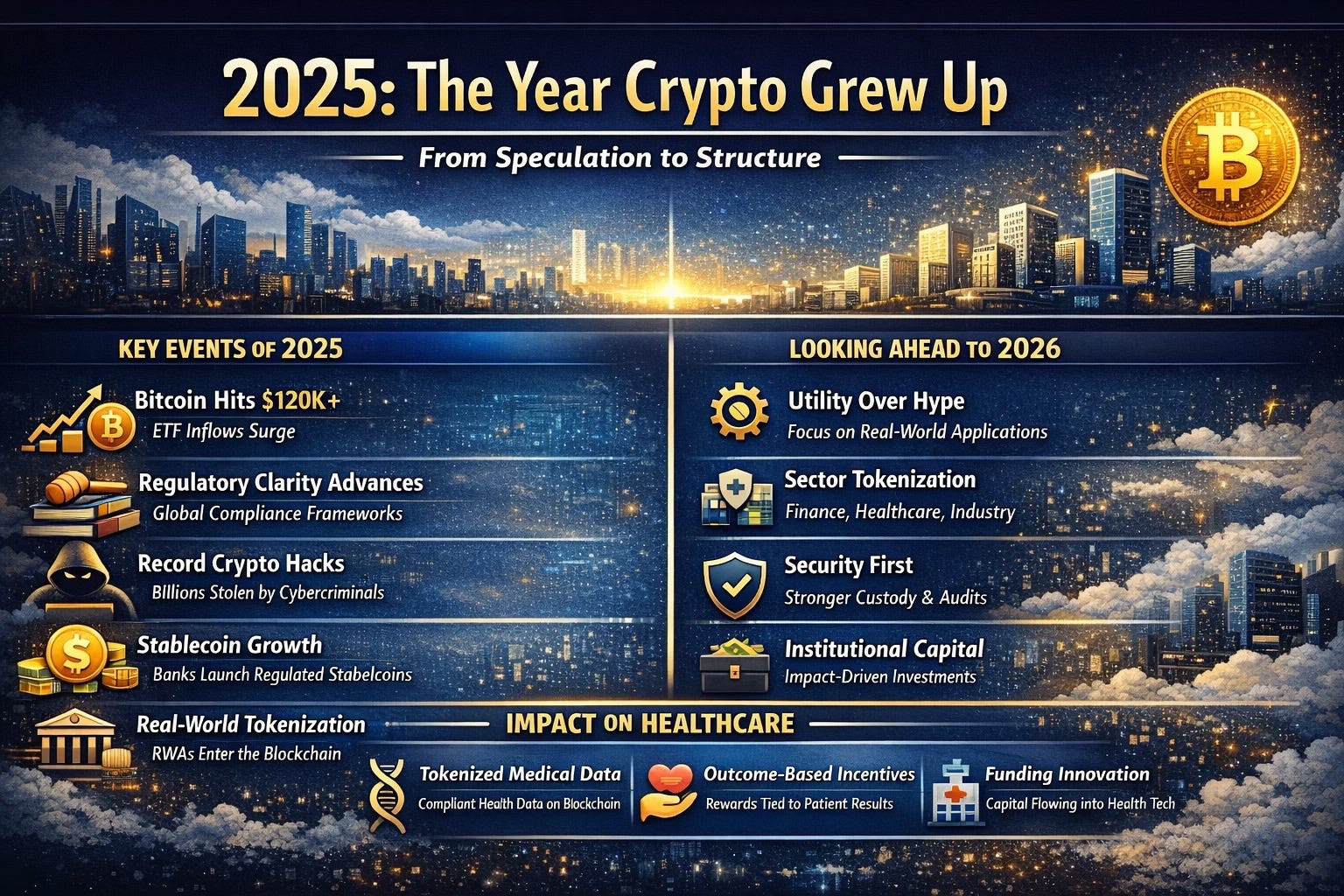
2025: 10 crypto events that shaped the year
Bitcoin reached a new all-time high and corrected sharply
In 2025, Bitcoin crossed approximately USD 126,000 before falling back to the USD 85,000–95,000 range. This showed that while crypto has matured, price volatility remains part of the ecosystem. Importantly, price movements were driven less by retail hype and more by institutional flows and macroeconomic signals. For healthcare leaders, this reinforces that crypto should be viewed as infrastructure and not short-term speculation.
Source: Reuters
Why it matters: crypto is maturing, but volatility is still part of the game.
Bitcoin ETFs attracted large institutional inflows
Spot Bitcoin ETFs recorded around USD 22 billion in inflows during 2025. These ETFs allowed traditional investors to gain exposure to crypto without handling wallets or private keys.
This marked a major step toward mainstream financial acceptance of crypto assets.
It also made crypto markets behave more like traditional capital markets.
Source: MarketWatch, Bloomberg
Why it matters: institutional money increasingly moves crypto prices like how big funds move equities.
Ethereum and Layer-2 Networks Gained Strong Traction
In 2025, Ethereum strengthened its position not only through institutional investment, but also through rapid adoption of Layer-2 (L2) networks such as Arbitrum, Optimism, Base and zk-based rollups. These networks significantly reduced transaction costs, and improved scalability while inheriting Ethereum’s security. As a result, healthcare-focused tokens and incentive models can now operate at scale without the cost and congestion limitations previously associated with Ethereum mainnet. Source: Bloomberg, Ethereum Foundation, Messari
Why it matters: Lower fees and faster transactions make healthcare tokenization and patient-level incentives economically viable at scale.
Crypto ETFs went mainstream as an asset class
Across Bitcoin, Ethereum, and diversified products, crypto ETFs collectively saw USD 30–35 billion in inflows in 2025.
This removed technical barriers for institutions and pension funds as crypto increasingly became part of standard portfolio allocation discussions.
This normalization is critical for regulated sectors like healthcare.
Source: Financial Times, Bloomberg
Why it matters: easier access = more adoption; also means crypto behaves more like traditional markets.
The U.S. passed a major stablecoin law (GENIUS Act)
The GENIUS Act (2025) introduced a regulatory framework for U.S. dollar-backed stablecoins. Stablecoins are digital currencies designed to maintain stable value.
This law clarified reserve requirements, consumer protection, and issuer obligations.
Stablecoins are now viewed as regulated digital payment instruments, not speculative assets.
Source: U.S. Congress, Wikipedia, Reuters
Why it matters: stablecoins are the “digital cash layer” that makes payments and settlement practical (including for real-world industries).
Europe’s MiCA regime pushed crypto toward regulated operations
The European Union continued implementation of MiCA (Markets in Crypto-Assets) regulations. MiCA defines licensing, governance and consumer protection rules for crypto firms.
This created a predictable environment for compliant platforms.
For healthcare-linked crypto use cases, regulatory clarity is essential.
Source: European Commission, ESMA
Why it matters: regulation is making compliant platforms like HUMB more valuable and non-compliant ones less survivable.
Crypto thefts reached record levels
Over USD 3.4 billion was stolen in crypto-related incidents in 2025, including one major USD 1.5 billion hack. This highlighted weaknesses in custody, access controls and operational security.
As a result, security became a board-level issue rather than a technical afterthought.
Healthcare-grade security expectations are now influencing crypto design.
Source: Chainalysis
Why it matters: “trust” is now engineered via custody, controls, audits and not vibes.
Crypto industry consolidation accelerated
Crypto mergers and acquisitions reached approximately USD 8.6 billion across 260+ deals in 2025. Larger firms acquired smaller players to gain licenses, technology or compliance capabilities.
This mirrors consolidation seen earlier in banking and healthcare IT sectors.
Fewer but stronger players are emerging.
Source: Financial Times
Why it matters: the industry is consolidating into fewer, larger, more regulated players like what happened in banking and exchanges historically.
Crypto IPOs came back in a big way
Several crypto companies went public in 2025, raising a combined USD 14+ billion.
Public listings forced higher standards of disclosure, governance, and audits.
This increased transparency improves trust for institutional and healthcare partners.
Crypto firms are increasingly held to public-market standards.
Source: Financial Times
Why it matters: public markets force higher disclosure and governance; another “grown-up” signal.
Legal accountability increased through private litigation
Even as some regulators reduced direct enforcement, private lawsuits increased.
Courts and investors became powerful enforcers of transparency and fair conduct.
This pushed crypto companies to strengthen disclosures and compliance controls.
The industry began resembling traditional financial services in legal accountability.
Source: Reuters
Why it matters: even when regulators are quieter, courts and investors can be very loud.
2025: 5 digital healthcare events that shaped the year
European Health Data Space (EHDS) came into force
The EHDS regulation officially entered into force in March 2025. It establishes rules for sharing health data across EU countries for care, research and policy.
This is a major step toward standardized, cross-border health data access as it lays the groundwork for interoperable digital health ecosystems.
Source: European Commission
Why it matters: interoperability and “data rules of the road” became more real, not theoretical.
FDA moved to formalize lifecycle expectations for AI medical software
In January 2025, the FDA released guidance on managing AI-based medical software across its lifecycle.
This includes training data quality, monitoring, updates and safety oversight.
It signals that AI in healthcare must meet the same rigor as clinical devices.
Innovation is encouraged but under governance.
Source: U.S. FDA
Why it matters: AI in healthcare is scaling, but under tighter safety and quality expectations.
Global regulators aligned on “Good ML Practice” principles
International regulators finalized GMLP principles for AI in medical devices aligning expectations across countries.
They help vendors design AI systems that are safe, explainable and auditable.
This reduces regulatory uncertainty for global healthtech deployments.
Source: IMDRF, FDA
Why it matters: more standardization = faster adoption with less regulatory uncertainty.
U.S. interoperability networks scaled under TEFCA
By late 2025, 10,600+ organizations were connected under Trusted Exchange Framework and Common Agreement (TEFCA), with 115 million+ documents exchanged.
This significantly improved data sharing across hospitals, labs and providers clearly signalling that interoperability is becoming infrastructure rather than a pilot project.
This enables data-driven care workflows at scale.
Source: ONC, TEFCA RCE
Why it matters: data exchange is becoming more “utility-like,” enabling better workflows and continuity of care.
Tokenization Crossed the Line from Concept to Capital
In 2025, tokenization of real-world assets (RWAs) moved beyond pilot projects into meaningful capital deployment. Tokenized assets such as U.S. Treasuries, private credit, and funds reached an estimated USD 30–35 billion in on-chain value, with active participation from banks, asset managers, and regulated platforms. This shift signaled that tokenization is no longer an experiment, but an emerging financial infrastructure layer.
Source: World Economic Forum, Boston Consulting Group, Messari
Why it matters: tokenization becomes credible for regulated industries like healthcare enabling outcome-based rewards and transparent value exchange.
Outlook for 2026: Structured Markets, Use Cases and Capital Discipline
The lessons of 2025 point to an evolution in crypto’s functional role in global financial systems. Multiple industry forecasts highlight where momentum is consolidating in 2026:
Capital Trends Move From Speculation to Infrastructure
In 2026, the mix of capital is steered more by utility and adoption than pure speculation. Institutional investors are channeling funds into infrastructure, tokenized assets and regulated products instead of margin-driven trading alone.
This aligns with a broader industry belief that crypto must earn its seat at the table through fundamental value, not just price narratives.
Stablecoins and Digital Money Become Core Rails
Stablecoins the programmable, fiat-pegged backbone of on-chain settlement are poised to serve as the digital dollar of the internet. Their adoption into treasuries, payments systems, and commerce elevates them from niche tools to foundational components of digital financial infrastructure.
This shift helps reduce friction for real-world business integration, especially where cross-border settlement and programmable flows matter.
Real-World Asset (RWA) Tokenization Gains Traction
Institutional capital is increasingly looking at tokenization of traditional assets (bonds, commodities, real estate), not for speculation but for liquidity, interoperability and fractional ownership.
This signals a market willing to invest where utility meets compliance.
Regulation and Oversight Continue to Evolve
Even as some regulators de-emphasize crypto-only exams in 2026, they are institutionalizing standards for fiduciary duty, custody and consumer protections, creating a framework that aligns digital assets with mainstream financial expectations.
This evolution paves the way for broader institutional deployment.
Implications for Healthcare: From Proof-of-Concept to Real Utility
Healthcare stands at an inflection point where blockchain is no longer just a theoretical tool; it’s a solution to real systemic challenges.
Exponential Growth of Blockchain in Healthcare and Tokenized Healthcare Data
The blockchain healthcare market is projected to grow from USD 5.5 billion in 2025 to USD 43.37 billion by 2030, at a CAGR of ~52%, reflecting deep interest in data sovereignty, security and digital workflows. As healthcare data becomes more interoperable and standardized, tokenization enables secure, permissioned and auditable data exchange. Instead of data being locked inside siloed systems, tokenized representations will allow stakeholders to verify when and how data is used without exposing sensitive patient information.
This growth trajectory coincides with broader industry shifts toward tokenized economic models.
Funding Innovation: Capital Flowing into HealthTech
As crypto markets mature in 2026 and tokenization gains institutional credibility, capital will increasingly flow into regulated, outcome-driven healthtech solutions rather than speculative applications. This capital flow will support scalable digital health platforms, AI-driven clinical tools with governance in place and infrastructure for secure data exchange and patient engagement
The result will be a healthier innovation ecosystem where funding will prioritize impact, sustainability and real-world adoption over hype.
Incentivized Patient Engagement and Outcome-Based Incentives
Healthcare has long struggled to align incentives with outcomes. Token-based incentive models enable rewards to be linked directly to verifiable patient actions and results, such as medication adherence, follow-ups, preventive screenings or lifestyle improvements. Blockchain’s verifiable event logging enables proof of care touchpoints, outcome verification and transparent reward mechanics. This approach bridges data, incentives and clinical engagement.
This combination enables a practical shift from “digital health collects data” to “digital health triggers actions and incentives.”
What This Means for HUMB: Strategic Alignment With Market Evolution
As the industry matures, HUMB’s position as a healthcare-focused, compliance-centric crypto exchange becomes uniquely prescient:
Compliance as a Competitive Advantage
In an era where regulators demand transparency and consumer protection, HUMB’s compliance-ready architecture isn’t a cost but a market differentiator. Clear regulatory frameworks (like the GENIUS Act) and policy movements reduce ambiguity and enable trusted platforms to scale.
Tokenization Built for Healthcare Workflows
HUMB can capitalize on the structural shift toward use-case tokenization, designing assets and markets tied to real healthcare value, such as care milestones, provider performance indicators and patient engagement outcomes.
This moves HUMB beyond an exchange into a healthcare economic infrastructure for tokenized activity.
Bridging Traditional and Digital Healthcare Economies
By integrating interoperable healthcare data standards with blockchain-native incentives, HUMB is creating ecosystems where:
Providers, patients and payers share aligned incentives
Data provenance is transparent yet privacy-preserving
Token economics reflect real value exchange
This aligns perfectly with macro trends in both crypto adoption and healthcare transformation.
In Conclusion
As we move into 2026, one conclusion is increasingly clear: the future of crypto and digital healthcare will not be defined by speed or speculation, but by trust, structure, and real-world impact.
Crypto is evolving into regulated financial infrastructure, while digital healthcare is building the data highways and governance frameworks needed for scalable, patient-centric care. Together, these shifts create a unique opportunity where verifiable data, secure digital value and aligned incentives can finally work in unison.
For healthcare stakeholders, this means moving beyond isolated digital tools toward integrated systems that reward participation, improve adherence, and measure outcomes.
For HUMB, it reinforces a clear strategic role: enabling a compliant, healthcare-focused token economy that bridges digital assets with real care workflows.
The groundwork has been laid in 2025.
2026 is where execution begins and where healthcare stands to gain the most.
Disclaimer: This article is intended for informational and educational purposes only. The views and opinions expressed are those of the author(s) and are based on publicly available information at the time of writing. They do not necessarily reflect the official position, strategy or policies of HUMB or any affiliated entities.
Thanks for writing this, it clarifies a lot. What if AI governance modles became transferable across sectors?