


The phrase “healthcare-grade blockchain” gets used often. Rarely is it defined.
Healthcare is not fintech. It is not gaming. It is not consumer Web3. It operates under strict regulatory frameworks, life-critical workflows and institutional accountability. If blockchain is going to function meaningfully in this sector, it must meet a very different standard.
So what actually qualifies as healthcare-grade blockchain architecture?

Let’s define it properly with examples, real gaps in today’s systems and the consequences of getting it wrong.
1. The Reality: Healthcare Data Is Already Broken
Before blockchain even enters the conversation, healthcare systems face deep structural challenges.
The Interoperability Gap
The U.S. Office of the National Coordinator (ONC) reports that while over 95% of hospitals use EHR systems, true interoperability remains fragmented.
A 2022 survey by the American Hospital Association found that only about 46% of hospitals could electronically exchange patient data across all care settings without major friction.
Globally, the World Health Organization has identified digital health fragmentation as a major barrier to coordinated care delivery.
Impact of the gap:
Duplicate testing
Administrative overhead
Delayed diagnoses
Higher costs
McKinsey estimates administrative inefficiencies account for roughly $250–300 billion annually in excess healthcare spending in the U.S. alone.
Blockchain won’t magically fix workflows—but it can address data verification, auditability and trust layers that sit above fragmented systems.
2. What “Healthcare-Grade” Actually Means
Healthcare-grade blockchain architecture must meet five core criteria:
A. Compliance-First Design (Not Compliance-Later Patching)
Healthcare data sits under strict regulatory regimes:
HIPAA (United States)
GDPR (European Union)
National health data localization laws
Clinical trial governance rules
A generic blockchain designed for token swaps is not designed for protected health information workflows.
Healthcare-grade architecture requires:
Permissioned data anchoring (not public PHI storage)
Consent-aware access logs
Audit trails that meet regulator standards
Clear governance structures
Without this, enterprises simply cannot adopt the system.
B. Event Anchoring, Not Raw Data Storage
One of the biggest misconceptions is that healthcare data should be stored directly on-chain.
That is neither practical nor compliant.
Healthcare-grade blockchain focuses on:
Anchoring proofs of clinical events
Timestamping consent records
Verifying claim submissions
Securing audit trails
The data remains in secure storage environments.
The blockchain stores proof of integrity, not sensitive records.
This dramatically reduces breach risk while improving accountability.
C. Consent as a Dynamic Mechanism
Today, patient consent is often:
Signed once
Stored statically
Rarely revisited
Healthcare-grade blockchain architecture allows:
Consent issuance
Revocation
Expiry tracking
Purpose-bound permissions
Given that healthcare data breaches affected over 133 million individuals in the U.S. in 2023 alone (HHS Office for Civil Rights data), patient-centric control is no longer optional, it is structural.
D. Market Integrity Around Healthcare Tokens
If a blockchain network includes tokenized utility, governance or data-access mechanisms, the surrounding market structure must also be healthcare-grade.
That means:
Regulated or structured exchange environments
Surveillance and monitoring
Controlled liquidity
Transparent listing standards
An unstructured speculative market undermines enterprise confidence.
Healthcare-grade architecture therefore includes not just the protocol but also the market rails that support it.
E. Governance That Mirrors Institutional Reality
Hospitals and regulators do not operate in anarchic environments. They function within hierarchical governance and liability frameworks.
Healthcare-grade blockchain architecture must therefore:
Define validator standards
Clarify node operator accountability
Provide transparent upgrade mechanisms
Ensure role-based permissions
Without governance clarity, adoption stops at pilot stage.
3. What Happens When Architecture Is Not Healthcare-Grade?
Let’s look at the impact of architectural gaps:
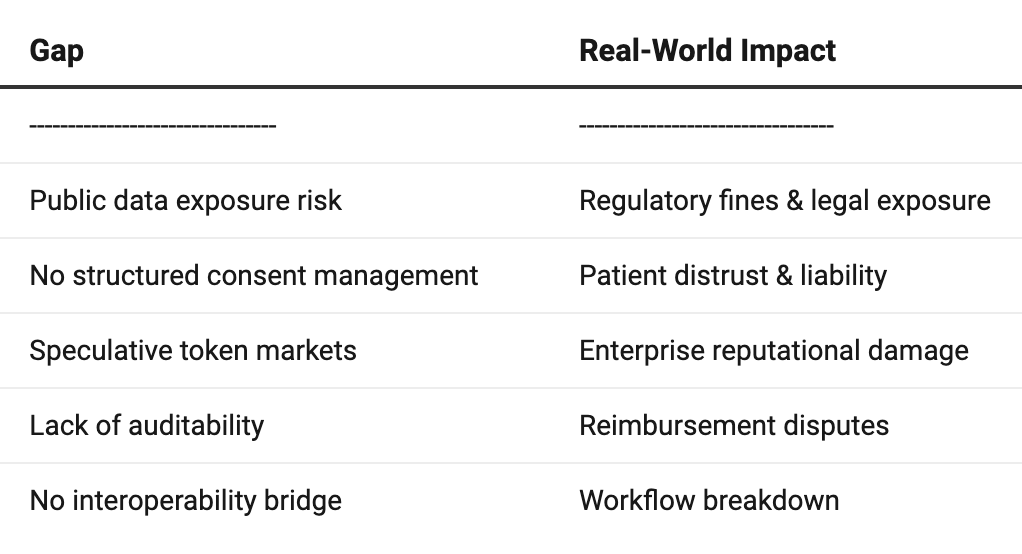
Healthcare organizations are inherently risk-averse.
A single compliance failure can cost millions in fines and reputational damage.
IBM’s Cost of a Data Breach Report (2023) found:
The average healthcare data breach costs $10.93 million per incident, the highest of any industry.
If blockchain increases risk instead of reducing it, it will not be adopted.
4. A Practical Example: What Healthcare-Grade Looks Like in Action
A healthcare-grade blockchain system might:
Anchor a timestamped consent event.
Allow a researcher access to anonymized data within scope.
Record proof that access was granted and used appropriately.
Enable audit verification without exposing patient records.
Use a utility token to pay for infrastructure services.
Trade that token within a structured exchange environment that aligns with healthcare compliance standards.
That’s not hype… That’s infrastructure.
Platforms like PranaChain are built on a simple but critical principle: anchor events, don’t expose data. Instead of placing sensitive medical records on-chain, the architecture records verifiable proofs consent issuance, clinical milestones, claims submissions creating immutable audit trails without compromising privacy. The result is a trust layer that allows institutions to validate what happened, when it happened and under whose authority. If a utility token is involved, structured market infrastructure such as that provided by HUMB Exchange ensures that trading dynamics do not undermine institutional credibility. The token powers the system, but the real innovation lies in the integrity layer that makes healthcare coordination verifiable and compliant.
If PranaChain is rebuilding the healthcare data layer, HUMB provides the marketplace where that innovation gains visibility, liquidity and community engagement.
5. The Bigger Impact
If healthcare-grade blockchain architecture becomes standard:
Duplicate tests decrease.
Claims disputes become auditable.
Consent management improves.
Research data integrity strengthens.
Administrative friction drops.
Even a 5–10% reduction in administrative inefficiency globally could represent tens of billions of dollars in savings annually.
More importantly, it restores trust.
6. Final Definition
Healthcare-grade blockchain architecture is not:
A public ledger for medical records
A speculative token ecosystem
A replacement for EHR systems
It is:
A compliance-aligned, event-anchored, governance-structured trust infrastructure designed specifically for regulated healthcare environments.
Healthcare doesn’t need louder technology.
It needs technology that respects reality where both infrastructure builders and compliant market platforms work together towards a common goal.
And that’s what healthcare-grade blockchain architecture is designed to deliver.
PranaChain - Is building healthcare-grade blockchain infrastructure and owns the PRN token that drives the healthcare-grade blockchain ecosystem. PRN token is exclusively listed on HUMB Exchange. Visit https://humb.io/in/tokens/prn-token for more details on PRN token.
HUMB Exchange - Is a fully regulated and complaint Virtual Assets Service Provider (VASP). PRN token is exclusively listed on HUMB Exchange and available for purchase. Visit app.humb.io/register to register on HUMB and purchase PRN tokens.
Disclaimer: The views and opinions expressed in this article are those of the author and are intended for informational and educational purposes only. They do not necessarily reflect the official position, strategy, or views of the company, its affiliates, or partners. This content should not be construed as financial, investment, legal, or medical advice. Readers are encouraged to conduct their own research and seek independent professional guidance where appropriate. For more information about HUMB and its initiatives, please visit humb.io