


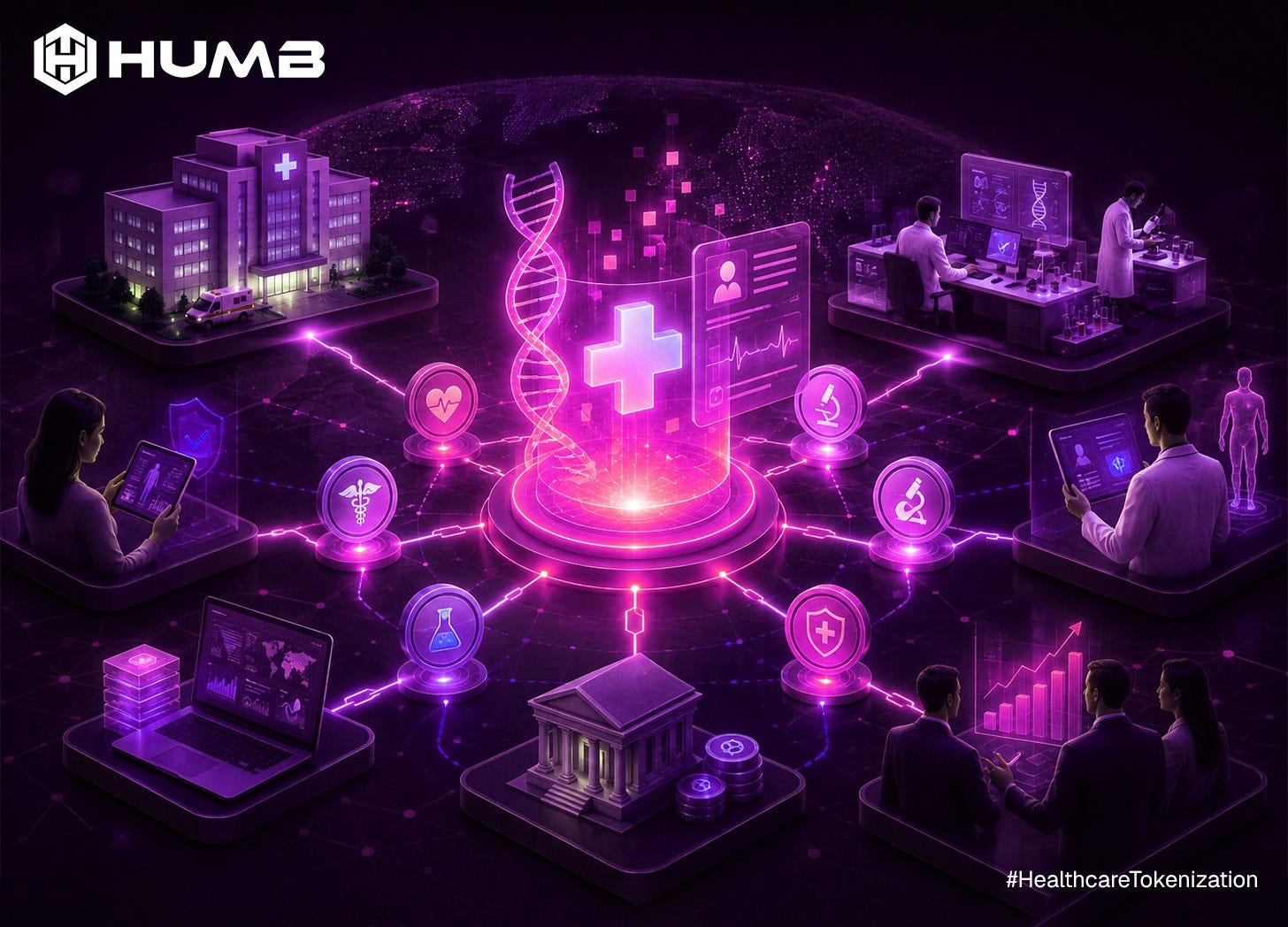
Healthcare is one of the world’s most important industries, but it still faces some very real challenges: fragmented medical data, limited funding access, slow innovation, lack of transparency, and complex systems that often keep patients, providers, researchers, and investors disconnected.
This is where healthcare crypto tokenization becomes a powerful new concept.
It combines blockchain technology, digital assets, and healthcare innovation to create a more transparent, accessible, and efficient ecosystem for medical data, healthcare funding, patient engagement, and real-world healthcare assets.
For a healthcare-focused crypto exchange like HUMB Exchange, tokenization is not just a financial trend. It is a bridge between digital asset markets and real-world healthcare transformation.
What Is Healthcare Crypto Tokenization?
Healthcare crypto tokenization is the process of converting healthcare-related assets, rights, data access, rewards, or utilities into blockchain-based digital tokens.
These tokens can represent different types of value within the healthcare ecosystem, such as:
Patient-consented healthcare data access
Medical research participation rewards
Healthcare project funding rights
Real-world medical equipment or infrastructure assets
Hospital, clinic, or diagnostic service-related utilities
Wellness, insurance, or patient engagement incentives
Healthcare-focused utility tokens used inside digital health ecosystems
In simple words, tokenization turns healthcare value into a secure, traceable, and programmable digital asset.
Instead of healthcare assets or data being locked inside isolated systems, tokenization can help make them more transparent, trackable, and accessible through blockchain-based infrastructure.
Why Does Healthcare Need Tokenization?
The healthcare industry has always produced massive value, but much of that value remains difficult to access, verify, or share.
Medical data is often stored across different hospitals, clinics, labs, apps, and insurance systems. This creates data silos. Patients may not always have full control over how their data is used. Researchers may struggle to access reliable consent-based data. Healthcare startups may face funding barriers. Investors may find it difficult to participate in early healthcare innovation.
Healthcare tokenization can help solve some of these problems by creating digital systems built around transparency, consent, access, and traceability.
It can support:
Better patient data control
More transparent medical research participation
Faster healthcare project funding
Improved liquidity for healthcare-related assets
Clearer ownership and access rights
More secure records of healthcare transactions
A new digital economy around healthcare innovation
This is why healthcare tokenization is gaining attention as one of the most meaningful use cases of blockchain beyond traditional crypto trading.
How Does Healthcare Tokenization Work?
Healthcare tokenization usually works through a structured blockchain-based process.
1. A Healthcare Asset or Utility Is Identified
The first step is identifying what will be tokenized.
This could be a healthcare project, medical device, diagnostic center, patient data access model, wellness platform, research program, healthcare reward system, or real-world healthcare asset.
For example, a healthcare token may be connected to a digital health platform where users are rewarded for participation, or to a healthcare infrastructure project that needs transparent fundraising.
2. The Asset Is Digitally Represented
Once the asset or utility is defined, it is represented as a digital token on a blockchain.
This token can carry specific rules, rights, and functions. These may include access rights, reward mechanisms, usage benefits, governance roles, or asset-backed participation depending on the project structure.
The token does not automatically mean ownership of a hospital, medical data, or company. Its meaning depends on the legal, technical, and compliance framework behind it.
3. Smart Contracts Manage Rules Automatically
Smart contracts are blockchain-based programs that execute predefined rules.
In healthcare tokenization, smart contracts can help manage:
Who can access data
When rewards are distributed
How token transfers happen
How usage rights are verified
How compliance rules are applied
How healthcare ecosystem participants interact
This reduces manual dependency and creates a more transparent digital process.
4. Consent and Compliance Are Built Into the System
Healthcare is a highly sensitive sector. Patient data, medical records, and healthcare services must be handled with strict privacy, consent, and regulatory controls.
A responsible healthcare tokenization model must include:
Patient consent
Data privacy protection
KYC and AML compliance
Clear token utility
Transparent risk disclosure
Secure custody and access systems
Regulatory alignment
This is one reason healthcare-focused tokenization should not be treated like ordinary meme coin speculation. It requires responsible infrastructure, compliance-first thinking, and real-world use cases.
5. Tokens Become Tradable or Usable Within an Ecosystem
Once issued, healthcare tokens may be used inside a digital ecosystem or listed on a crypto exchange, depending on regulatory approval and project readiness.
This is where platforms like HUMB Exchange become important.
A healthcare-focused exchange can provide a dedicated trading environment for healthcare tokens, making it easier for users to discover, understand, and participate in healthcare-related digital assets.
Real-World Examples of Healthcare Tokenization
Healthcare tokenization can take many forms.
Patient Data Tokenization
Patients may give consent for their anonymized health data to be used in medical research. In return, they may receive digital rewards or tokens. This creates a more patient-centric data economy where individuals have more control over how their data is used.
Medical Research Tokenization
Research organizations can use token-based systems to improve transparency in funding, participation, and data access. Contributors, patients, and researchers can interact through a more traceable system.
Healthcare RWA Tokenization
Real-world healthcare assets such as diagnostic equipment, clinics, medical facilities, or healthcare infrastructure can be tokenized to create new funding and participation models.
This can help healthcare asset owners raise funds while giving digital asset participants access to healthcare-linked opportunities.
Wellness and Reward Tokens
Healthcare and wellness platforms can use tokens to reward users for healthy actions, fitness goals, preventive care participation, or medical adherence programs.
This creates stronger engagement between users and healthcare platforms.
Healthcare Utility Tokens
Some tokens may provide access to services, discounts, platform features, digital health tools, or ecosystem participation within healthcare-focused blockchain platforms.
Benefits of Healthcare Crypto Tokenization
Healthcare tokenization can create benefits for multiple stakeholders.
For patients, it can support better data ownership, consent-based participation, and possible reward models.
For healthcare providers, it can improve transparency, digital coordination, and new funding possibilities.
For researchers, it can create access to better-quality, consent-driven datasets.
For startups, it can unlock new ways to raise capital and build healthcare ecosystems.
For traders and investors, it can create exposure to healthcare-focused digital assets with real-world utility potential.
For the broader industry, it can support a more connected, transparent, and innovation-friendly healthcare economy.
Challenges and Risks
While healthcare tokenization has strong potential, it also comes with important challenges.
Healthcare data is highly sensitive. Any tokenized system must protect privacy and follow applicable laws. Poorly designed tokens may create confusion around ownership, value, or rights. Projects without real utility may expose users to unnecessary risk. Regulatory treatment can differ across countries.
That is why education, due diligence, and trusted platforms matter.
Users should always understand:
What the token represents
What utility it provides
Who is behind the project
Whether the project has real healthcare relevance
What risks are involved
Whether the platform follows compliance standards
Healthcare tokenization is powerful, but it must be built responsibly.
Why HUMB Exchange Focuses on Healthcare Tokens
HUMB Exchange is built around a clear vision: connecting the digital asset economy with real-world healthcare innovation.
Unlike general crypto exchanges that list thousands of unrelated assets, HUMB focuses on building a dedicated ecosystem for healthcare tokens, digital assets, and blockchain-based healthcare use cases.
Through healthcare token listings, launchpad opportunities, real-world asset tokenization concepts, and secure trading infrastructure, HUMB aims to make healthcare-focused digital assets easier to access, understand, and trade.
For users, this means one platform where crypto trading meets healthcare innovation.
For healthcare projects, it means a focused ecosystem where real-world medical, wellness, research, and infrastructure ideas can gain visibility.
For the industry, it represents a new direction: digital assets with purpose beyond speculation.
The Future of Healthcare Tokenization
Healthcare tokenization is still early, but its potential is significant.
As blockchain, AI, digital health, medical data systems, and real-world asset tokenization continue to develop, healthcare tokens may play an important role in shaping the next generation of healthcare finance and innovation.
The future may include:
Patient-controlled health data marketplaces
Tokenized healthcare infrastructure funding
Blockchain-based medical research networks
Healthcare reward ecosystems
Real-world medical asset tokenization
More transparent healthcare investment models
Better connectivity between patients, providers, and digital platforms
Healthcare crypto tokenization is not just about creating another token. It is about building a more open, transparent, and efficient healthcare economy.
Final Thoughts
Healthcare is not only an industry. It is a global necessity.
Tokenization gives healthcare a new digital layer where value, access, consent, and transparency can be managed more efficiently.
For HUMB Exchange, this represents a major opportunity to support the future of healthcare innovation through secure, compliant, and purpose-driven digital asset trading.
The next wave of crypto may not only be about finance.
It may be about better health, better access, and better systems for everyone.
HUMB Exchange - where digital assets meet healthcare innovation.